

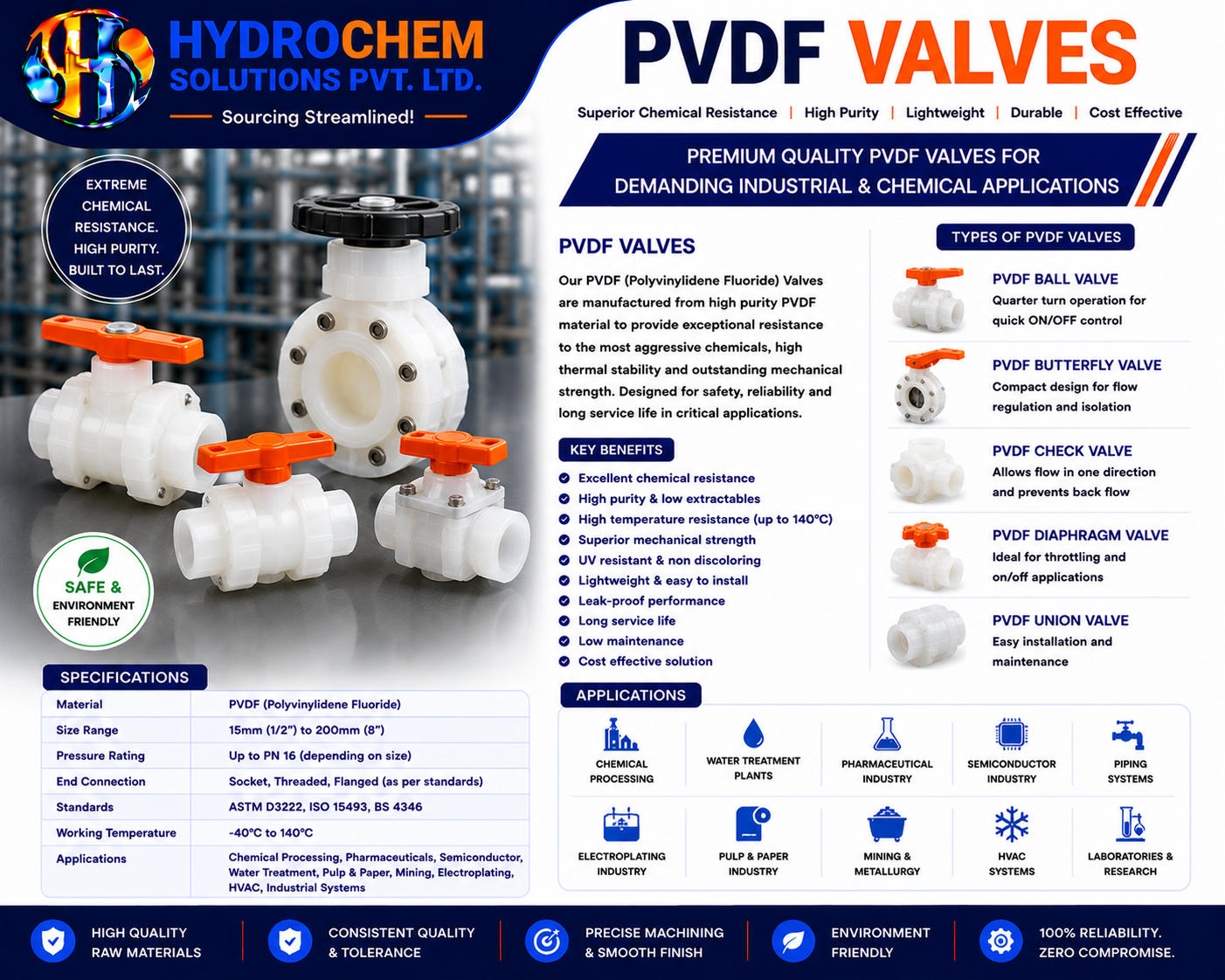



PVDF Valves
PVDF valves are industrial flow control devices made from Polyvinylidene Fluoride (PVDF), a high-performance thermoplastic known for its excellent chemical resistance, high temperature stability, and mechanical strength. These PVDF valves are designed to control, regulate, or stop the flow of liquids and gases, especially in corrosive or high-purity environments. A PVDF valve is a corrosion-resistant plastic valve used in chemical, water treatment, pharmaceutical, and industrial piping systems where metal valves may fail due to chemical attack. PVDF is heated and handled before being used in extrusion and injection moulding to make PVDF pipes, sheets, coatings, films, and moulded PVDF goods including bulk containers.
PVDF valves are an excellent way to easily control the flow of water and other liquids. The Polyvinylidene Fluoride (PVDF), is a fluorocarbon chemical compound. It has high insolubility and exceptional toughness, making it an excellent coating material for protecting metal substrates against corrosion. PVDF valves are chemically resistant even to the most difficult-to-handle situations, such as hot, concentrated sulfuric acid. It is a thermoplastic with similar adaptability to other thermoplastics, notably fluoropolymers, for applications.
| Property | Description / Typical Value |
| Material | PVDF (Polyvinylidene Fluoride) |
| Density | ~1.78 g/cm³ |
| Melting Point | 170–175 °C (338–347 °F) |
| Glass Transition Temp ($T_g$) | ~−40 °C to −35 °C (Becomes brittle below this) |
| Thermal Conductivity | 0.17–0.19 W/m·K |
| Coefficient of Thermal Expansion | 100–130 ×10⁻⁶ /°C |
| Tensile Strength | 35–50 MPa |
| Elongation at Break | 20–50% |
| Hardness (Shore D) | 70–75 |
| Impact Resistance | High (good toughness, resistant to cracking) |
| Chemical Resistance | Excellent to acids, bases, and most solvents |
| UV Resistance | Excellent (Inherently stable; one of the best for UV) |
| Color | Natural (off-white) or colored with additives |
| Operating Temperature Range | -40 °C to +140 °C (continuous use) |
1. Customization Options
a) Valve Type & Function
- Ball Valves: On/off control for chemical or water systems.
- Diaphragm Valves: Precise flow regulation, ideal for corrosive fluids.
- Check Valves: Prevent backflow in pipelines.
- Globe & Gate Valves: Throttling and isolation applications.
- Custom designs can combine features, like multi-port valves or three-way valves.
b) Size & Pressure Rating
- PVDF valves can be customized for pipe diameters from ½ inch to 12 inches or more.
- Pressure ratings can be increased using reinforced PVDF (glass-filled or carbon-filled).
c) End Connections
- Socket Fusion (Solvent Weld) – for small piping systems.
- Flanged (DIN, ANSI, JIS standards) – for larger, industrial pipelines.
- Threaded Ends (NPT, BSP) – for modular or low-pressure applications.
- Custom Connections – to fit existing equipment or non-standard piping.
d) Seal & Seat Materials
- Seals can be tailored to the chemical and temperature requirements:
- PTFE – general chemical resistance.
- FKM/Viton – high temperature resistance.
- FFKM – extreme chemical resistance for aggressive fluids.
- EPDM – acids, bases, and water systems.
e) Special Coatings & Additives
- Reinforced PVDF – improves mechanical strength.
- Carbon or glass-filled PVDF – for wear or temperature resistance.
- UV-stabilized PVDF – for outdoor applications.